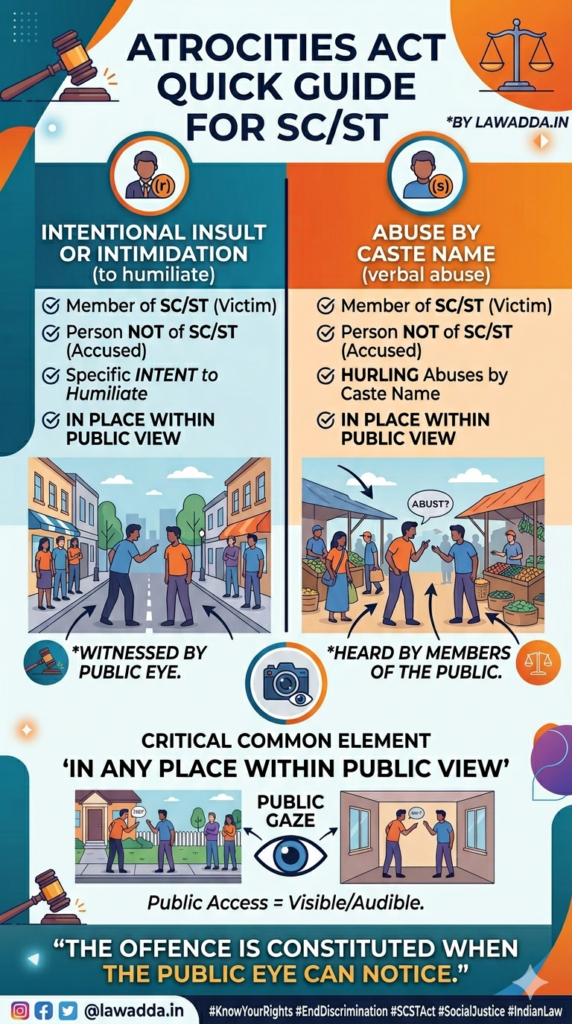
Sections 3(1)(r) and 3(1)(s) of the SC/ST Act read as under,
“3. Punishments for offences atrocities.—3(1) Whoever, not being a member of a Scheduled Caste or a Scheduled Tribe,—
(a) to (q) ………..
(r) intentionally insults or intimidates with intent to humiliate a member of a Scheduled Caste or a Scheduled Tribe in any place within public view;
(s) abuses any member of a Scheduled Caste or a Scheduled Tribe by caste name in any place within public view;”
The offence under Section 3(1)(r) of the SC/ST Act can be said to have been committed when a person not belonging to Scheduled Caste or Scheduled Tribe intentionally insults or intimidates with an intent to humiliate a person belonging to Scheduled Caste or Scheduled Tribe in any place within public view. Offence under Section 3(1)(s) of the SC/ST Act is made out when any member of the Scheduled Caste or Scheduled Tribe is abused by caste name in any place within public view.
The ingredients of the offences are that there has to be an intentional insult or intimidation which has to be with an intent to humiliate a member of Scheduled Caste or Scheduled Tribe or that such member of Scheduled Caste or Scheduled Tribe is abused by caste name by a person who does not belong to Scheduled Caste or Scheduled Tribe. The common essential for constituting the offence under both the Sections is that the insult or intimidation under subclause (r) or hurling of abuses under sub-clause (s) have taken place “in any place within public view.
The expression ‘a place within public view’ could not be confused with the expression ‘public place’. A place can be a private place yet can be within public view.
For Example – If the offence is committed outside the building e.g. in a lawn outside a house, and the lawn can be seen by someone from the road or lane outside the boundary wall, the lawn would certainly be a place within the public view. Also, even if the remark is made inside a building, but some members of the public are there (not merely relatives or friends) then also it would be an offence since it is in the public view.
To be a place ‘within public view’, the place should be open where the members of the public can witness or hear the utterance made by the accused to the victim. If the alleged offence takes place within the four corners of the wall where members of the public are not present, then it cannot be said that it has taken place at a place within public view.
In order to make out the offence under Section 3(1)(r) and/or Section 3(1)(s) of the SC/ST Act, the occurrence of the incident and the act and conduct of hurling of castebased abuses must take place at “a place within public view”. It must be a place within the public gaze. Even if it happens to be a private place, then in such eventuality a public-eye must have an access to be able to notice what happens there or what is taking place that will only make the “place within public view.