
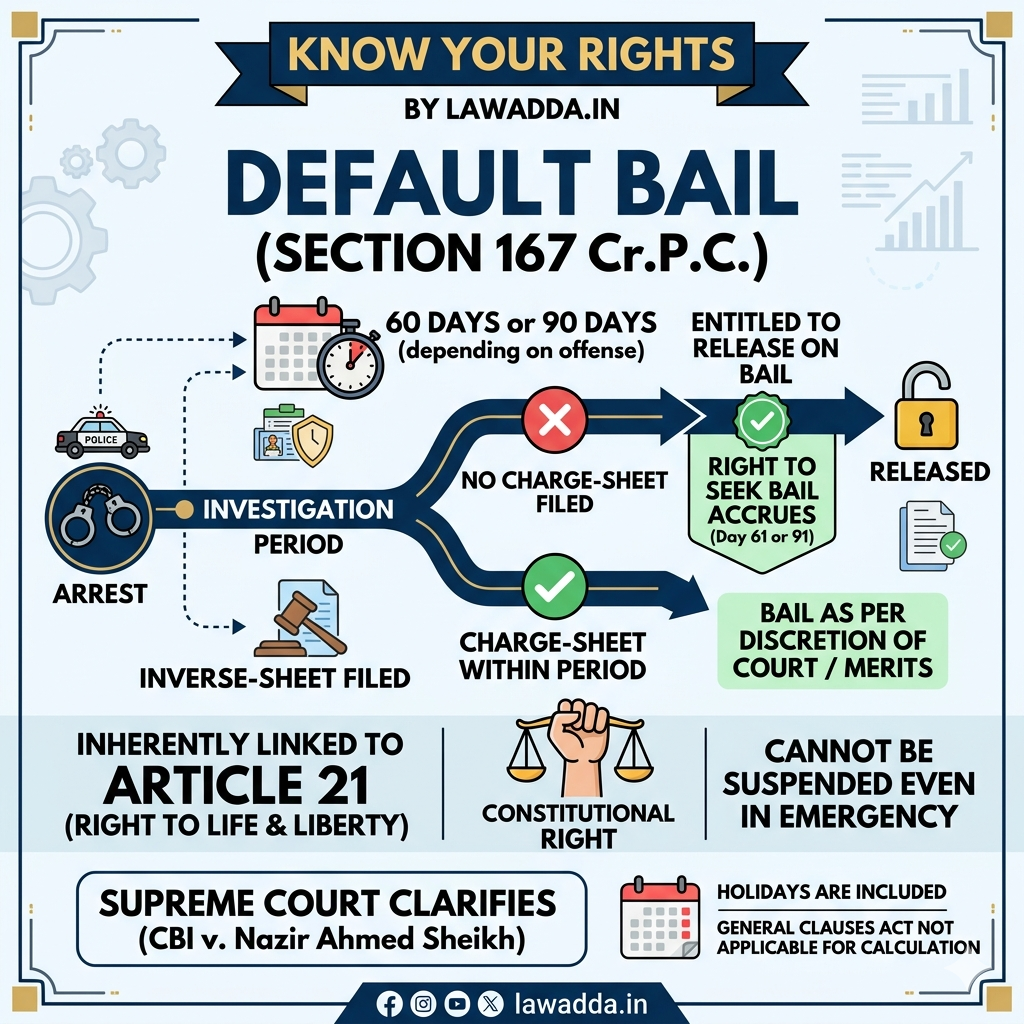
Default bail is also known by the name ‘compulsory bail’, as the grant of bail upon meeting the eligibility requirements is indispensable. It is also known as ‘statutory bail’, as the bail is granted by virtue of a statutory provision. If the investigation is not completed within the prescribed custody period, the Magistrate shall order the release of the accused by complying with the requirements of default bail under Section 167(2) of the Cr.P.C and that any detention of the accused beyond the prescribed period without the chargesheet being filed would be considered an illegal act.
Default bail is availed when the accused person becomes eligible for it after meeting the set requirements. Those requirements are:-
- Application by the accused – In order to avail the benefit of default bail it is mandatory that the accused should file an application before the Court praying for his release on bail. The mandate of Section 167 requires the advocate of the accused to formally file an application stating that since the period of remand has expired and no charge-sheet has been filed, the accused is liable to be released on bail. Default bail is an indefeasible right of the accused but in order to enjoy the same the accused is required to approach the court in the procedure prescribed.
- Investigation should be pending – Filing of chargesheet by the police means investigation is completed. Once the charge-sheet is filed the provision of Section 167 is no longer applicable since it is a pre-cognizance stage. Therefore the accused can avail the benefit of default bail only if the charge-sheet has not been filed within the prescribed period i.e. period of 60 days (or 90 days in the case of offences punishable with death or imprisonment for not less than 10 years). Default bail is available only during the pendency of the investigation. Thus it is important that the application for default bail should be filed before the filing of the charge-sheet. If the accused fails to do so and a charge-sheet is filed meanwhile then his right extinguishes. Thus, if an accused falls short of asserting his claim to be enlarged on bail for the failure of investigating agency to file challan within time permissible by law, then the accused cannot emphasize that he had an indefeasible right to exercise at any time notwithstanding the fact that in the meantime the charge-sheet is filed.
What if Chargesheet and application for default bail filed on the same Day?
If charge-sheet and bail applications are filed on the same day, the Court cannot ignore the charge-sheet and will go on to decide the application for default bail presuming absence of the charge-sheet. In this situation, the Court will consider the charge-sheet and not the application for default bail as by filing of the charge-sheet, the stage for application of bail will expire.
It provides that, wherein the investigation is not completed within the prescribed period of 60 or 90 days, as the case may be, thereafter the accused can avail his right of default bail on the expiry of the said period. In other words, where the investigation agency has not filed a charge-sheet within a period of 60 days (or 90 days in the case of offences punishable with death or imprisonment for not less than 10 years) of the investigation then the accused becomes entitled to be released on bail. Thus, where no charge-sheet has been filed within the stipulated period the accused can no longer be detained in custody, on the expiration of such period. Hence, on 61 or 91 days of remand, the right to seek default bail accrues in favour of the accused.
The police file a chargesheet or challan or final report when the investigation of the case gets complete. Hence, if upon the lapse of the sixty or ninety-day period, the police fail to file the chargesheet, then the accused gets empowered to exercise the right to default bail.
The right to default bail cannot be suspended even in an emergency scenario, as the same is deemed to be inherently linked with Article 21 of the Constitution, a right which cannot be superseded even after the proclamation of emergency.
In the Supreme Court case of CBI v. Nazir Ahmed Sheikh, the Court held that the holidays will be included while calculating the period for filing of chargesheet under Section 167of the Cr.P.C. The statutory custody period as provisions of Section 10 of the General Clauses Act do not apply.
Related Post: